
A History of the Copa Libertadores - Hipsters welcome
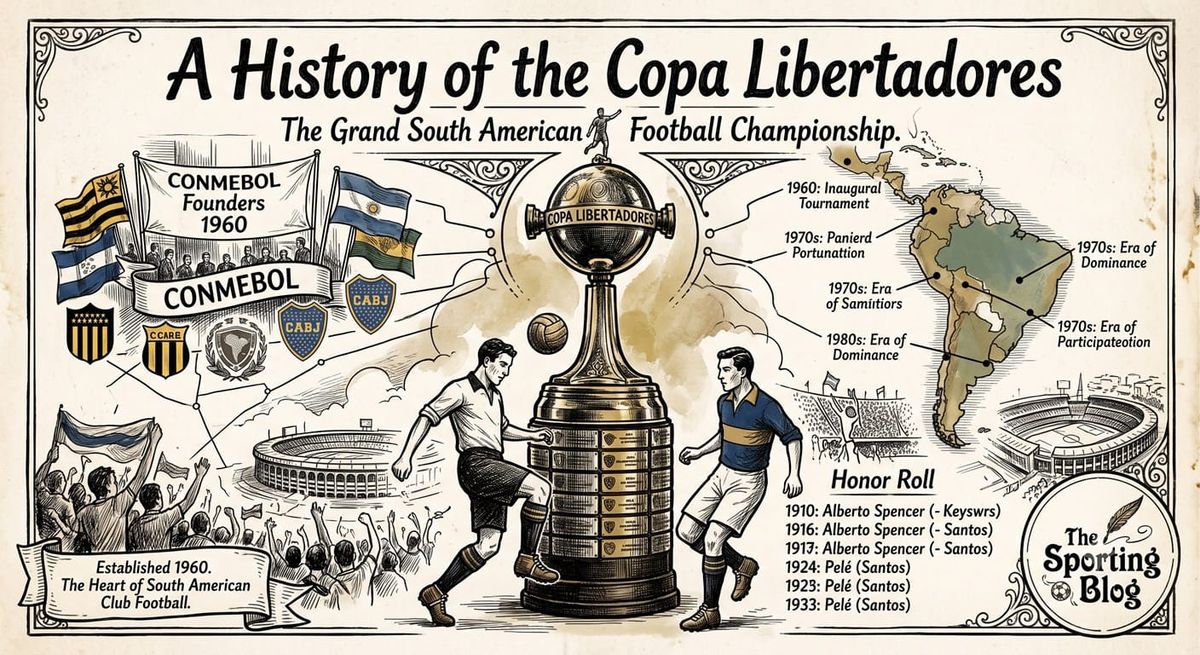
Copa Libertadores - Not just for Hipsters
A journalist once said that the Copa Libertadores was the hipster’s favourite event, and he might be right. But he is also extremely wrong to denigrate the competition as some meaningless competition only relevant in South America.
New writer, Sam Harris, decided to take a closer look at the Copa and its history, in his first outing for The Sporting Blog.
South American Champions League
The Copa Libertadores is the South American equivalent of the Champions League and has been held every year since 1960, with at least four clubs from Brazil, Argentina, Bolivia, Chile, Colombia, Ecuador, Peru, Uruguay and Venezuela competing each year.
Teams can qualify in several ways, with the winners of the half-season Apertura and Clausura tournaments in Bolivia, Colombia, Ecuador, Paraguay, Peru and Venezuela earning qualification.
Brazil and Argentina offer places to the top-four in their respective leagues as well as the winner of their domestic cup competitions, while the top-three in Chile’s Primera División and the winner of the Copa Chile qualify.
The champions and runners-ups of the Primera División in Uruguay and the two sides with the best season aggregate earn qualification.
A side also earns automatic qualification by winning the Libertadores, although if the title holders qualify for the tournament through their domestic performance, an additional entry is granted to the next eligible team.
Group stage matches are awarded three points for a win and one for a draw, with extra time in the knockout matches but no away goals.
How the Copa Libertadores works
Held over a six-to-eight month period, the Copa begins with 12 sides, not including those from Brazil, Argentina, Chile and Colombia, competing in the first stage in two-legged knockout ties.
The six winners from the first stage progress to the group stage to be joined by 26 other sides, where they are split into eight groups of four who play home and away matches against the other sides in their group.
At the end of the group stage, the top two in each group qualify for the knockout stage, where two-legged matches are held in the quarter-finals and semi-finals.
The final is now a one-off encounter played at a neutral venue.
The final has always been held in South America every year apart from 2018, when, due to safety concerns after an attack on the Boca bus, the second leg of their encounter with rivals River Plate took place at Real Madrid’s Bernabeu stadium.
Independiente and Boca Copa kings but the Mexican and Peruvian wait goes on
Argentine side Independiente have won the competition a record seven times, including four consecutively from 1972 to 1975, but have not triumphed since 1984.
Boca Juniors, who lost to Santos in this year’s semi-finals, have appeared in the most finals, victorious six times but also runners-up on five occasions, the same as Uruguayan club Penarol.
Colombia’s America have participated in four finals without winning one, the most in the competition’s history, with defeats in 1985, 1986, 1987 and 1996.
Mexico and Peru are the only two countries to have not supplied a Copa winner, with the former seeing Cruz Azul (2001), Guadalajara (2010) and UANL (2015) fall at the final hurdle while Peruvian sides Universitario (1972) and Sporting Cristal (1997) finished runners-up.
The most successful country is Argentina with 25 wins across seven clubs.
Olimpia of Paraguay claimed the title in 1974, beating Boca to become the first side from outside Brazil, Argentina or Uruguay to lift the trophy.
The most successful manager in Copa history is Argentina’s Carlos Bianchi who claimed four titles in 1994, 2000, 2001 and 2003 with Velez Sarsfield and Boca Juniors.
Croatia’s Mirko Jozic led Colo-Colo to victory in 1991 to become the first European winner while legendary Portuguese coach Jorge Jesus lifted the title in 2019 with Flamengo.
Comments ()