
How Rare Is an MLB Unassisted Triple Play? History, Stats & Full Sequence
"Only happened 15 times in 150 years"
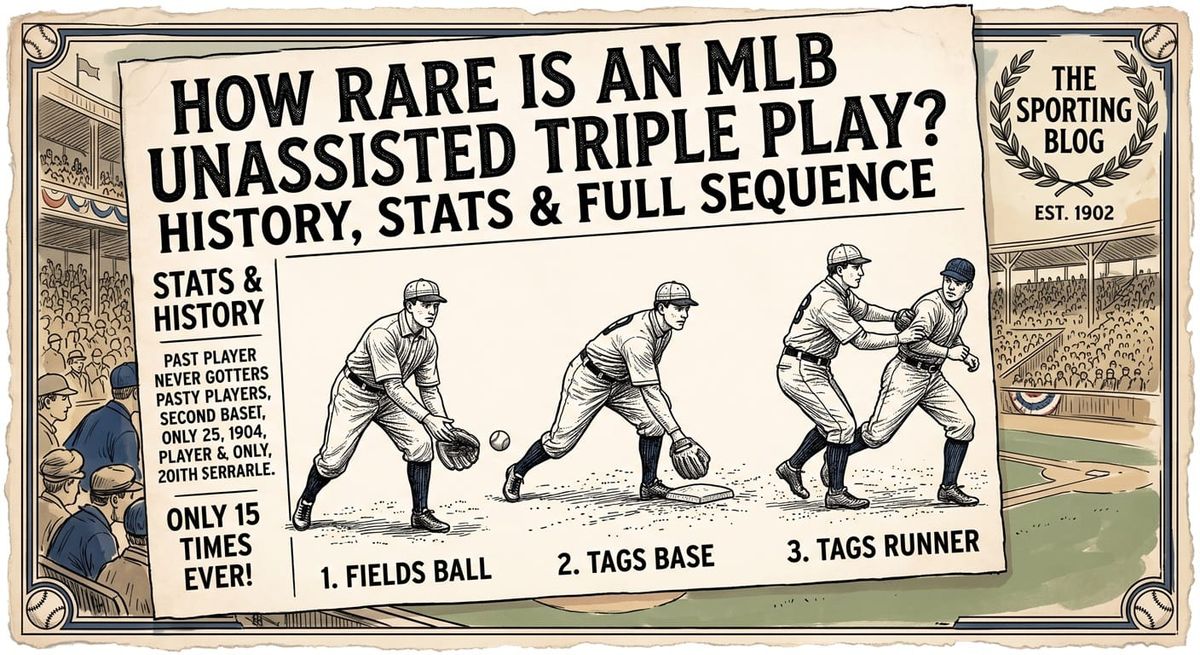
An unassisted triple play is one of the rarest statistical anomalies in Major League Baseball, executed only 15 times in over 150 years of professional play.
To put that scarcity into perspective, a pitcher is more likely to throw a perfect game (24 instances in MLB history) than a single infielder is to record three outs on a single batted ball without touching another defender's glove.
The conditions required for an unassisted triple play demand an almost impossible intersection of luck, strategy, and rapid reflexes.
The Anatomy of the Sequence
For an infielder to pull this off, the offensive team almost always needs to have runners on first and second base moving on a hit-and-run or steal attempt.
| Step | Action | Mechanical Focus |
| Out 1 | Catch Line Drive | Snaring a sharp line drive hit directly up the middle or toward the bag. |
| Out 2 | Touch Second Base | Stepping on second to double off the lead runner already breaking for third. |
| Out 3 | Tag Trail Runner | Tagging the trailing runner caught in no-man’s-land sprinting toward second. |
The Historic Fall Classic First
While regular-season occurrences are scarce enough to vanish across decades, the most iconic iteration happened on baseball's biggest stage.
During Game 5 of the 1920 World Series on October 10, Cleveland Indians second baseman Bill Wambsganss etched his name into folklore. In the fifth inning against the Brooklyn Robins, Pete Kilduff and Otto Miller took off on a hit-and-run. Clarence Mitchell lined a shot directly to Wambsganss.
Wambsganss snared the liner, took two strides to touch second base, and spun to tag Miller standing flat-footed.
It remains the only unassisted triple play ever recorded in postseason history—a 10-second sequence that stands as one of the ultimate feats in professional sports.
An unassisted triple play is rarer than a perfect game, having occurred only 15 times in over 150 years of MLB history.
Comments ()