
When Did Tennis Balls Change From White to Yellow? And Why?
"Because of David Attenborough?"
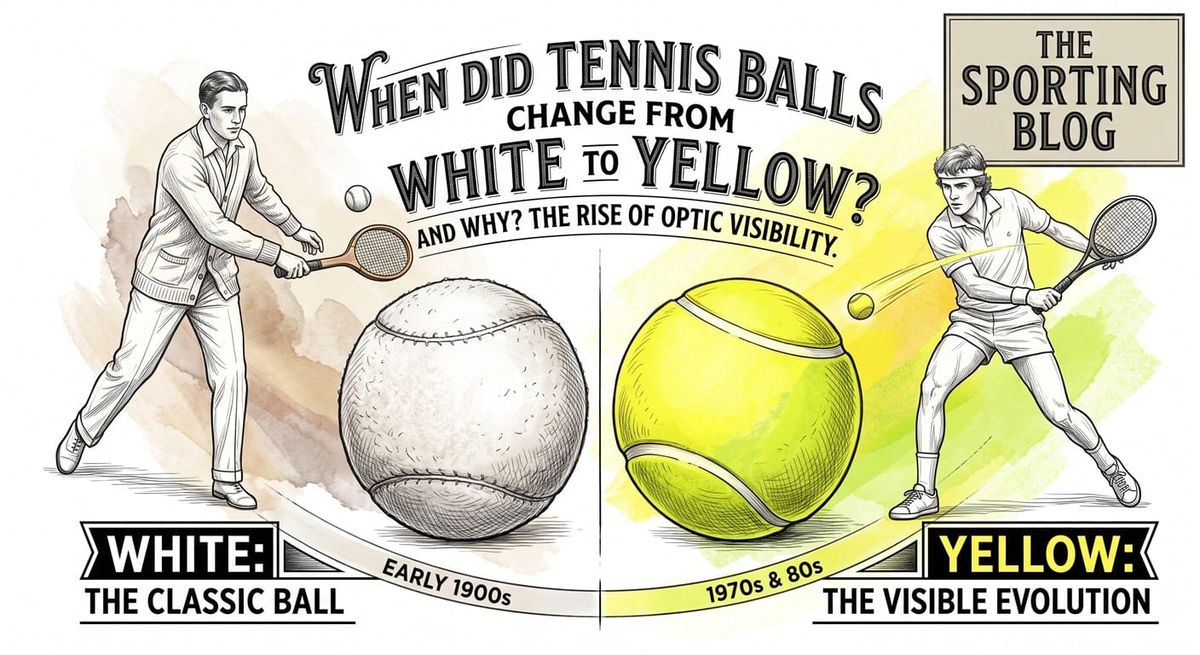
Tennis balls officially changed from white to yellow in 1972, a calculated shift sparked by the rapid rise of color television.
For nearly a century, competitive tennis relied almost entirely on traditional white or black felt balls, depending on court surface contrast. But as broadcasting shifted from grainy monochrome feeds to living room color sets in the late 1960s, a major problem emerged: viewers couldn't track the ball.
The Television Problem
Under early 1970s TV lighting, white felt vanished the moment it crossed chalk lines or blurred against pale court backgrounds.
A young David Attenborough, then a BBC television executive, recognized the issue and proposed a solution to the ITF: Changing the ball color.
The International Tennis Federation (ITF) commissioned comprehensive visibility research, testing various pigments under broadcast conditions. The result was "Optic Yellow"—a fluorescent shade engineered precisely to maximize human eye tracking across standard cathode-ray screens.
The ITF officially sanctioned Optic Yellow in 1972, and tournaments around the world adopted it almost overnight.
1970s Broadcast Visibility: White vs. Optic Yellow
| Feature | Traditional White Ball | Optic Yellow Ball (1972) |
| Court Line Contrast | Blends in completely when hitting white boundary lines | Stark contrast against white chalk lines |
| Grass Court Tracking | Bleaches out under direct sunlight and bright stadium glare | High-visibility pop against deep and faded turf alike |
| Broadcast Clarity | Ghosting effect and frequent loss of ball trajectory on TV | Remains sharp and trackable through fast rallies |
| Felt Wear | Picked up dirt quickly, darkening to an unreadable grey | Fluorescent core retained brightness even when scuffed |
The Lone Holdout: Wimbledon
While the US Open embraced yellow felt in 1978 during its move to Flushing Meadows, the All England Lawn Tennis Club dug its heels in.
Steeped in strict traditionalism, Wimbledon resisted the change for 14 years. It was not until 1986 that SW19 finally retired the traditional white ball, bringing Grand Slam tennis fully into the neon era.
Tennis balls were traditionally white for a century until the dawn of color television forced a neon yellow revolution for broadcasting clarity.



Comments ()