
Why Badminton Shuttlecocks Are Made of Goose Feathers: The Left-Wing Secret
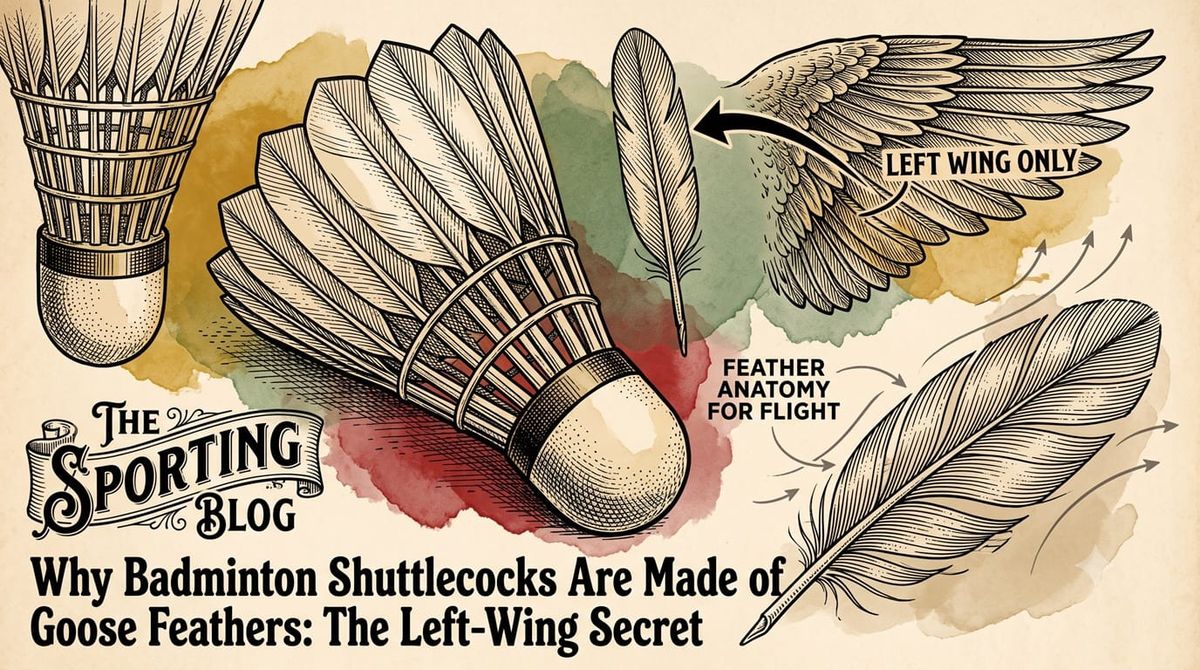
Professional badminton shuttlecocks are made of goose feathers because only natural quills offer the precise structural stiffness and airflow dynamics required for elite play.
While synthetic nylon shuttles work well for casual backyard games, tournament play demands extreme aerodynamic precision. Every official feather shuttlecock relies on a specific biological quirk that modern synthetic manufacturing still struggles to replicate.
The secret comes down to exact symmetry, uniform air resistance, and natural quill curvature.
The Aerodynamic Anatomy of a Shuttlecock
To understand why goose feathers reign supreme, you have to look at how the quills interact with air resistance immediately after impact:
If a manufacturer accidentally mixes feathers from a goose’s left and right wings, the opposing natural curves fight against one another. This airflow conflict causes the projectile to wobble, lose speed unpredictably, and drift off-course.
| Shuttlecock Feature | Aerodynamic Function & Dynamics |
| 16 Left-Wing Feathers | Constructed using exactly 16 feathers taken exclusively from the left wing of a goose for uniform curvature. |
| Clockwise Rotation | Overlapping left-wing quills direct airflow to create a consistent, clockwise rotation at speeds over 400 km/h. |
| Air Pocket Dynamics | Feather overlap creates micro-air pockets along the cone, instantly stabilizing the shuttle after a racquet strike. |
| Thick Rachis Structure | Goose quills feature a stronger, stiffer shaft than duck feathers, resisting deformation under high smash forces. |
Goose feathers are specifically favoured over duck feathers for professional competition because their quills are significantly thicker and more durable, ensuring the shuttle maintains its shape through intense rally exchanges.
Professional badminton shuttlecocks are strictly left-wing dominant; mixing feathers from both wings causes the projectile to wobble and track off-course.

Comments ()