
Why Are Padel Rackets Full of Holes? Explaining The Physics of Aerodynamics
"Why do Padel Rackets have holes?"
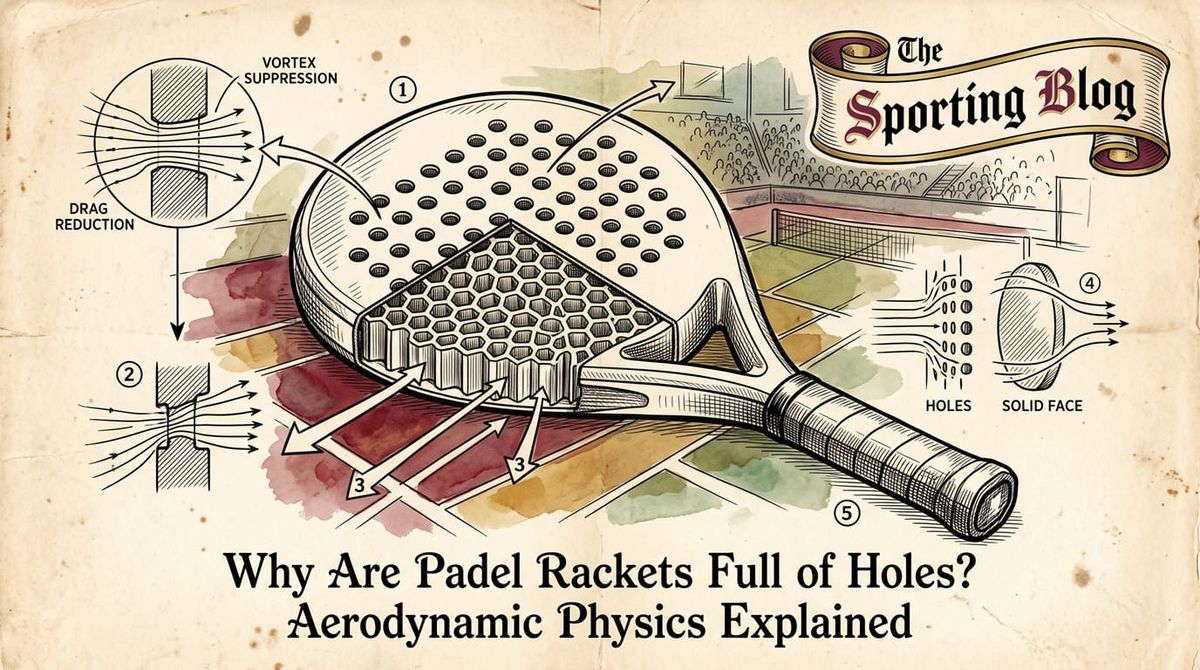
Padel rackets are full of holes to drastically reduce aerodynamic drag, allowing players to swing rapidly while preventing severe arm fatigue.
Unlike tennis rackets with open string beds or pickleball paddles with solid faces, a padel racket is a dense composite blade made of EVA foam wrapped in carbon fiber or fibreglass. Swinging a completely solid board through the air would create immense wind resistance.
To solve this, official FIP (International Padel Federation) Rule 1.1 requires rackets to be perforated across the central area with an unlimited number of cylindrical holes measuring between 9mm and 13mm in diameter.
Aerodynamics: Solid vs. Perforated Surfaces
The drill pattern transforms a solid wind-blocking paddle into an aerodynamically efficient sporting tool.
Beyond air resistance, these cylindrical cutouts give engineers control over the racket's flex and balance. Changing the density, diameter, and placement of the holes alters the size of the sweet spot and adjusts structural stiffness without adding extra weight.
Without these precise perforations, fast-reaction volley exchanges and high-speed overhead smash shots would be nearly impossible to execute smoothly.
| Surface Configuration | Drag Coefficient & Swing Mechanics |
| Solid Surface (Unperforated) | High aerodynamic drag. Pushes a massive wall of air, forcing your shoulder and forearm to fight extreme resistance on every stroke. |
| Perforated Surface (9–13mm Holes) | Low aerodynamic drag. Air channels directly through the hollow core, increasing swing speed and maneuverability at the net. |
Padel rackets aren't full of holes for style; without those exact 9-13mm perforations, your arm would give out from aerodynamic drag within ten minutes.



Comments ()