
Why Do Table Tennis Paddles Have Two Different Colors?
"Why black and red?"
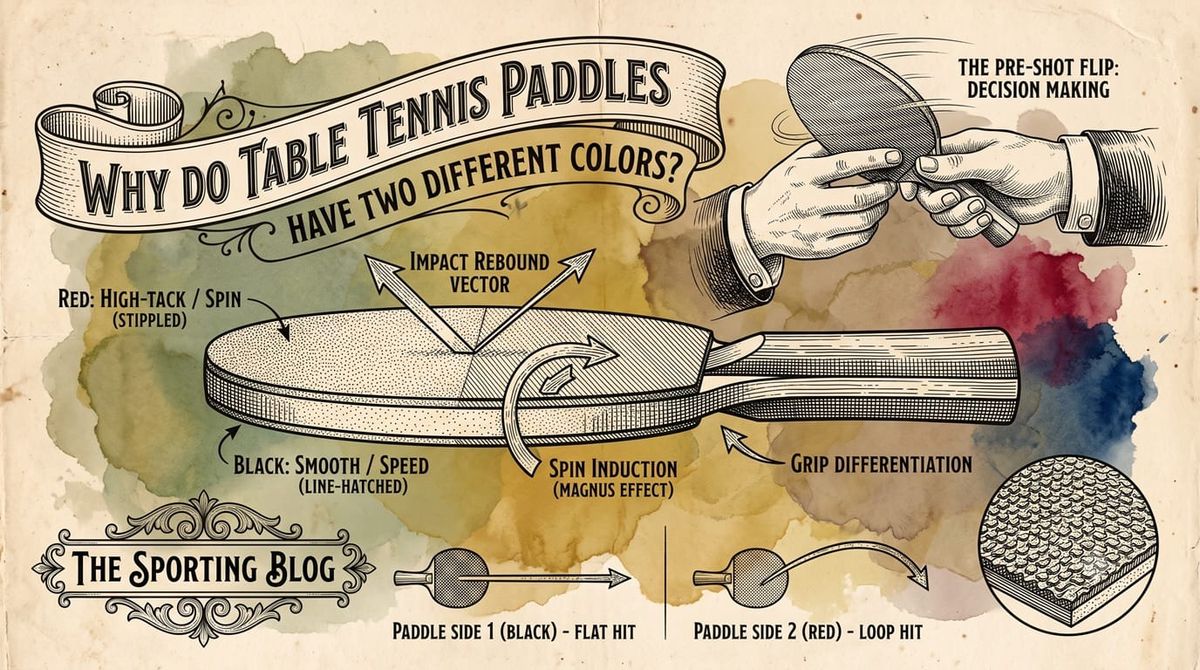
Table tennis paddles (or bats) have two different colors to prevent players from using identical-looking rubbers with opposite spin characteristics to deceive their opponents.
Before the mid-1980s, table tennis players could put the exact same color rubber on both sides of their paddle while using two completely different rubber types. By twirling the racket rapidly between shots, competitors generated wild spin variations that were virtually impossible to read.
The "Invisible Spin" Era & Rule 2.4.7
To eliminate this "invisible trick spin," the International Table Tennis Federation (ITTF) instituted Rule 2.4.7 in 1986. The rule mandated that one side of the paddle must be black and the opposite side must be a contrasting bright color (traditionally red, though recent rules also allow blue, pink, purple, and green).
| Rubber Surface Type | Friction & Ball Dynamics |
| High-Tack / Inverted Rubber | High friction; grips the ball to produce extreme topspin or heavy backspin. |
| Frictionless / Anti-Spin Rubber | Near-zero friction; completely neutralizes incoming spin and returns a dead, erratic ball. |
Because these two surfaces behave in opposite ways upon impact, color-coding forces complete transparency during a rally.
When an opponent twirls their paddle mid-point, the contrasting colors allow you to instantly recognize which rubber face will strike the ball and anticipate the resulting spin trajectory.
Ping pong paddles are legally required to be two different colors because 1980s players mastered the art of the "invisible trick spin."



Comments ()