
Why Tom Dempsey's Custom Kicking Shoe Was Banned by the NFL
"A 63-yard kick seemed improbable without some help"
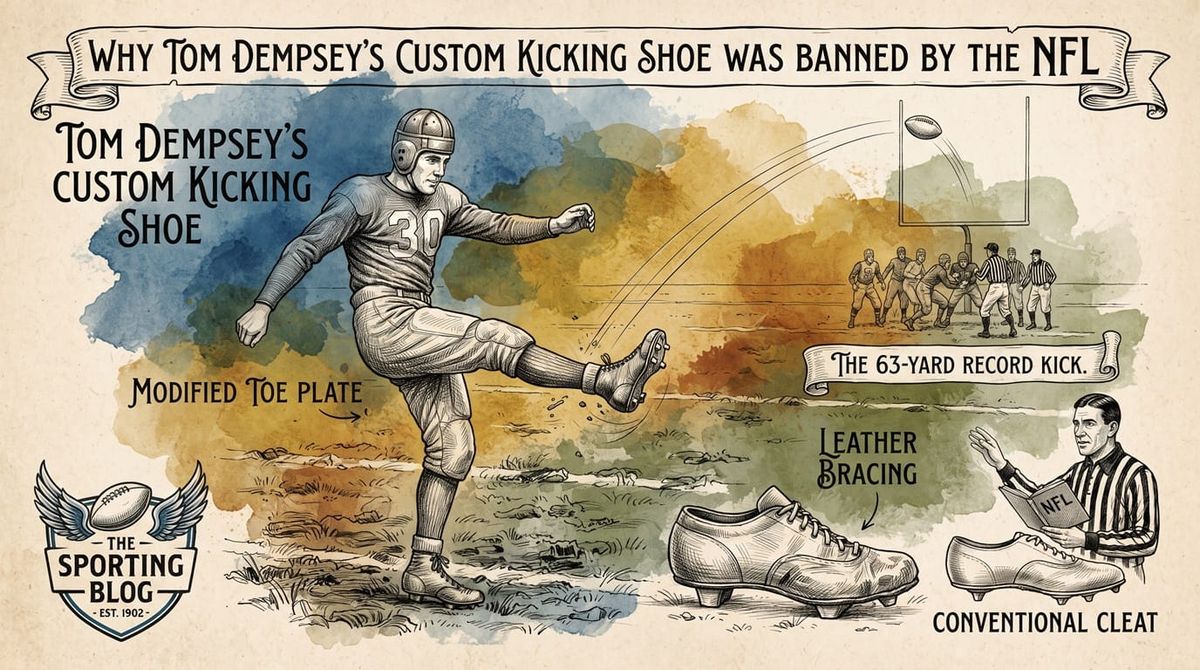
Tom Dempsey’s famously customized half-toe kicking shoe changed NFL history forever before the league swiftly legislated it out of existence.
In 1970, New Orleans Saints kicker Tom Dempsey stunned the sports world by booting a record-shattering 63-yard field goal to defeat the Detroit Lions.
Born without toes on his right foot, Dempsey wore a specially modified boot featuring a flat, hardened wooden block front. This unorthodox design gave him an unusually large surface area to compress the ball, creating massive propulsion that traditional round-toed cleats simply couldn't match.
Naturally, opposing coaches and players immediately 'kicked' up a fuss.
Critics argued the squared-off surface acted like a tee rather than a shoe, conferring an unfair mechanical advantage.
The Regulatory Fallout
Pressure mounted across the league over the competitive fairness of modified equipment. In 1977, the NFL officially intervened by amending its rulebook to close the loophole.
| Feature | Tom Dempsey’s Custom Boot | Standard NFL Kicking Cleat |
| Toe Design | Hardened, flat-front squared block | Standard tapered, rounded toe |
| Surface Area | Maximum flat impact zone | Conventional curved contour |
| Regulatory Status | Banned under Rule 5, Section 4 | Fully compliant |
Popularly dubbed the "Dempsey Rule," Rule 5, Section 4, Article 3 mandated that all kicking shoes must conform to the normal shape of a standard football shoe.
The ruling effectively grandfathered out any bespoke orthotics that altered the fundamental mechanics of striking the ball.
Dempsey's iconic 1970 record stood alone for decades, eventually tied by Jason Elam, Sebastian Janikowski, and David Akers before being broken. Yet the unique boot that made it possible remains one of football's most fascinating equipment anomalies.
A single custom orthopedic boot revolutionized NFL placekicking history and forced the league to rewrite its rulebook forever.

Comments ()