
Why You Have to Warm Up a Squash Ball: The Liquid Steam Physics Explained
"Why do you have to warm up a squash ball?"
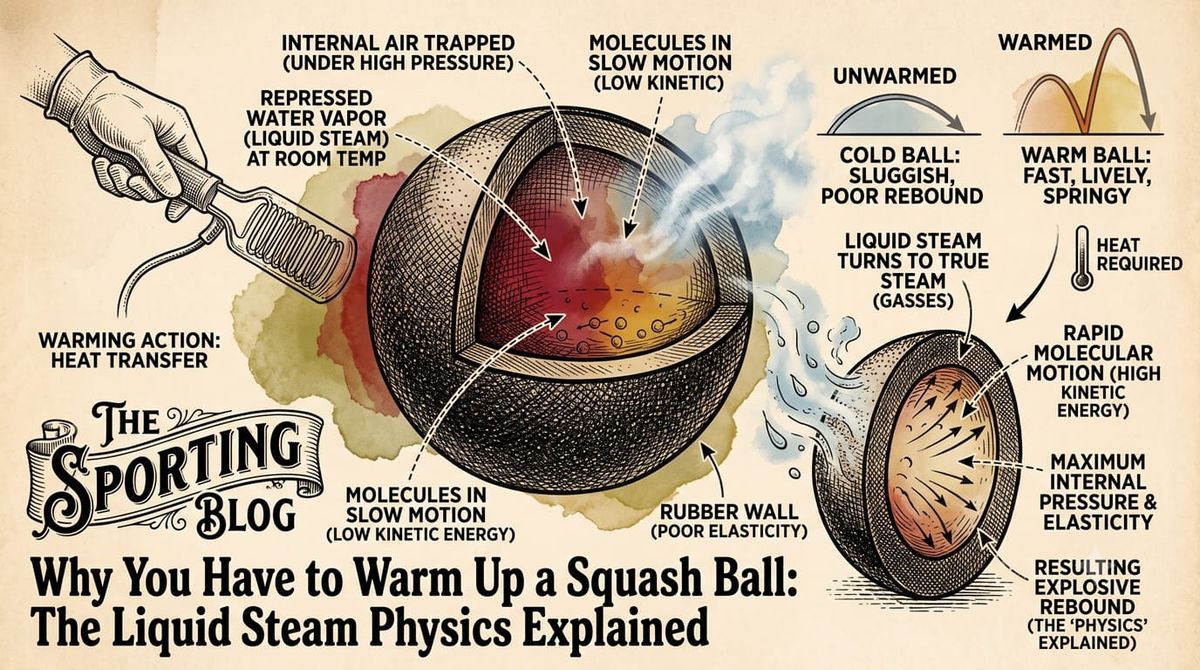
A professional squash ball is literally dead weight until you hit it hard enough to turn the drop of liquid water hidden inside into pressurised steam.
If you drop a cold squash ball on the court, it will barely bounce an inch. Unlike tennis or basketballs, which rely on pre-inflated air pressure, a squash ball relies on thermal physics to come alive.
To make the ball play properly, players have to strike it hard against the walls for a few minutes before a match.
The Material Physics Behind the Bounce
The construction of a squash ball is a tiny engineering marvel designed specifically for high-intensity indoor play.
During a warm-up, the mechanical energy from repeated high-velocity impacts transfers directly into thermal energy inside the hollow chamber.
As the temperature reaches approximately 45°C (113°F), the liquid water inside undergoes a phase change, turning into gas. This rapid expansion increases the internal pressure of the ball, while simultaneously softening the surrounding synthetic rubber compound.
The result is a dynamic, fast-bouncing ball that responds predictably to precision shots.
| Component / Parameter | Physics Function & Dynamics |
| Raw Rubber Core | Encapsulates the inner chamber; highly stiff and unyielding at room temperature. |
| Internal Water Droplet | Encapsulated inside the hollow core; must reach ~45°C (113°F) to vaporize. |
| Gaseous Phase Change | As liquid turns to steam, internal pressure spikes, transforming dead rubber into a lively rebound. |
| Thermal Equilibrium | Continuous hard impacts during play keep the internal steam pressure active and consistent. |
If play slows down or stops for too long, the ball quickly cools, the steam condenses back into liquid water, and the ball returns to its inert, frozen state.
A professional squash ball is literally dead weight until you hit it hard enough to turn the drop of liquid water hidden inside it into steam.


Comments ()