
What Is the NFL Fair Catch Kick Rule? How Teams Score Without a Snap
"One of the NFL's rarest loopholes"
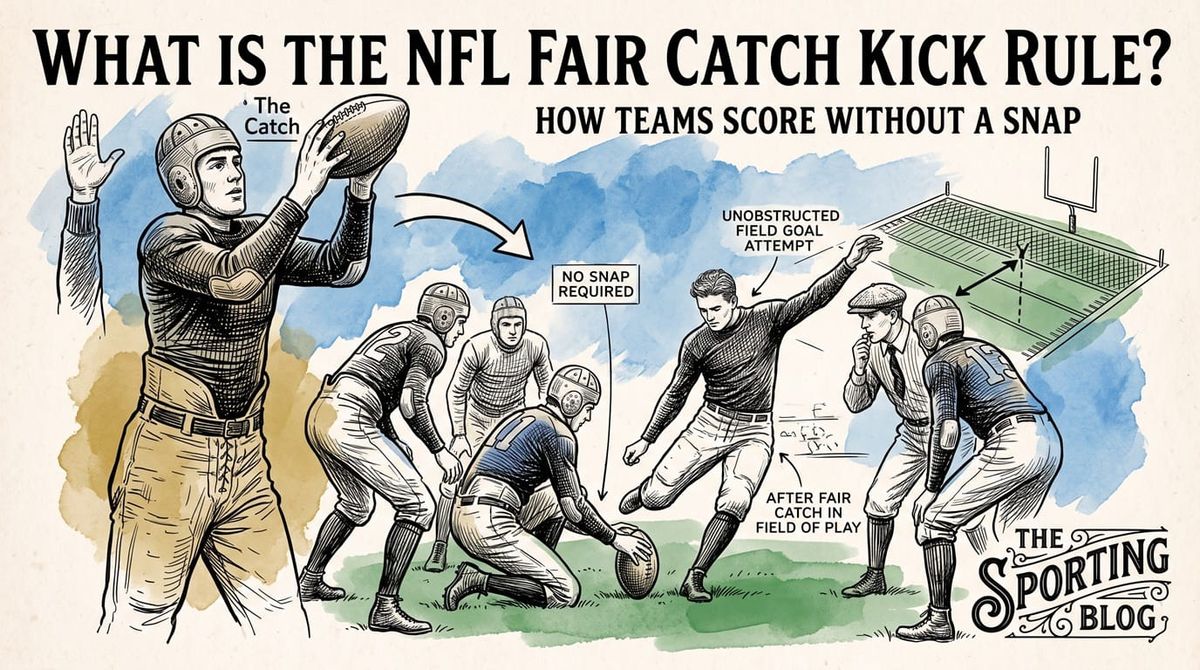
The NFL fair catch kick rule is one of professional football’s rarest loopholes, allowing a team to attempt a 3-point field goal on a free kick immediately following a fair catch.
Governed by Rule 10, Section 2, Article 4 of the official NFL rulebook, the fair catch kick bypasses the standard line of scrimmage entirely. Instead of running a traditional offensive play with a long snap, holding, and defensive pass rush, the receiving team is awarded an unhindered shot at the uprights.
How the Free Kick Works
Because the attempt is treated as a free kick rather than a scrimmage play, the entire dynamic on the field shifts:
| Fair Catch Kick Feature | Rule Execution |
| Line of Scrimmage | None. The ball is kicked from the exact spot of the fair catch. |
| Defensive Buffer | The defense must line up at least 10 yards behind the ball until it is kicked. |
| Defensive Rush | Zero pass rush. Defenders cannot cross their 10-yard restraint line until contact. |
| Kick Type | The kicker may use a placekick (held by a teammate) or a dropkick, but no tee. |
| Value & Outcome | 3 points if made. If missed, the defending team takes possession at the spot of the kick. |
When Teams Actually Use It
The play is extraordinarily rare because the situational stars must align perfectly. It only makes sense with single digits on the game clock at the end of a half or regulation.
If a team fair-catches a short punt near midfield as time expires, they can extend the half with one untimed fair catch kick. The kicker gets a clean, full run-up from distance with no charging defenders in their face—turning a desperate hail-mary situation into a realistic 3-point scoring opportunity.
You can score a 3-point field goal in the NFL without snapping the ball, facing a pass rush, or using a tee—thanks to the fair catch kick rule.

Comments ()