
A Complete History of the NFL Helmet
"Everything you need to know about American football head protection"
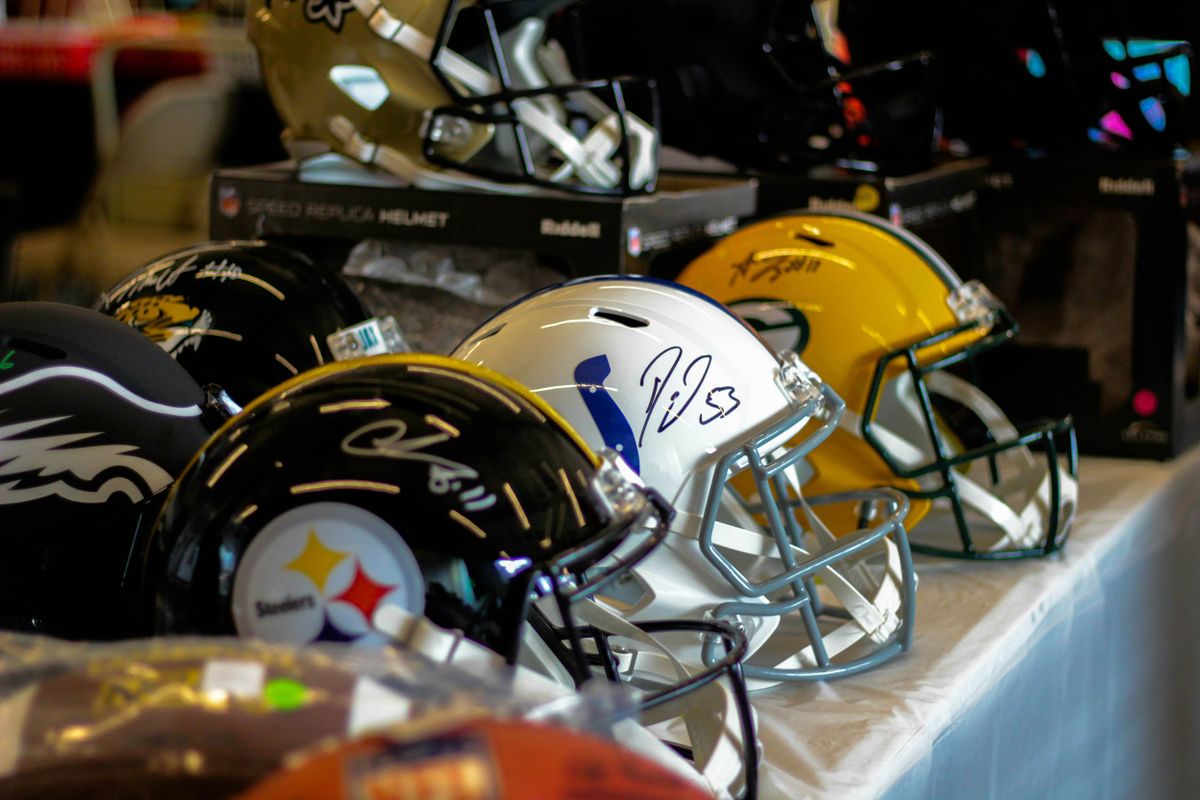
A Complete History of the NFL Helmet: From Leather Caps to Plastic Shells
The NFL helmet has moved from stitched leather to engineered polycarbonate — but how did it get there? When did helmets become mandatory in the NFL? The Sporting Blog tells all…
This is a full history and chronology of the NFL helmet over the years, including what players used to wear and how modern testing now guides big decisions. Let’s dive in!
Leather Beginnings (c. 1900s-1930s)
Early professional NFL players wore soft leather “skull caps”, then hardened leather helmets with ear flaps and chinstraps. The Smithsonian’s National Museum of American History catalogues a Rawlings leather helmet dated “ca. 1920”, a representative artefact of what pre-war pros used.
Even in the 1920s and 1930s, variations started to appear, including intimidating full-leather face coverings used by some semi-pro teams. This shows that protection and identity were already part of the conversation long before plastics.
From Fibre to Plastic: The War Years (late 1930s–1940s)
By the mid-to-late 1930s, fibre-shell helmets were in circulation. The NFL’s historical photo gallery documents a Chicago Bears fibre-shell helmet from 1934, bridging leather to plastic.
A major step came with John T. Riddell’s plastic web-suspension helmet in 1939. This became a template for football after proving useful for wartime head protection. The same design was then applied to sport.
But the most significant rule change arrived in 1943: helmets finally became mandatory in the NFL. The same offseason, owners approved free substitution.
The Face Mask Era (1950s–1960s)
In the post-war era, plastic shells spread across the league, and face masks emerged to protect the lower face and jaw. The Cleveland Browns’ team history revisits the oft-told Otto Graham moment in November 1953, when an opponent’s elbow struck him in the face.
This was one of the catalysts for the single-bar era. However, it wasn’t this single incident that “invented” the mask; change came incrementally.
As face masks proliferated, rules evolved. The NFL’s current rulebook explains the face mask foul. This mandates that players can’t grab, twist or control another player via their mask. The mask is protective equipment, not a handle.
At the same time, the league tightened equipment specifications. The Hall of Fame’s “Changing the Rules” archive reproduces a rulebook excerpt that specifies helmet, chinstrap and mask requirements, including diameter measurements. Construction was regulated, even all those years ago.
Looking for more? Check out our history of the NFL logo — it’s a fascinating read!
A Time for Helmet Standards and Certifications (1970s)
The 1970s brought a formal testing regime. The National Operating Committee on Standards for Athletic Equipment (NOCSAE) published the first football helmet performance standard in 1973. This has been revised more than 50 times as data and science have advanced.
That standard, still maintained today, introduced headforms and injury metrics to pass or fail helmet evaluation.
During this period, multi-bar, position-specific cage designs also began to supplant the minimal single-bar helmets used by most positions. This was helped by advances in material production and a growing reconditioning industry.
The Modern Shell (1990s–2000s)
By the 1990s and early 2000s, the big manufacturers iterated shell geometry, padding systems and stabilising chinstraps. Riddell’s corporate releases in the 2000s document the industry’s shift from legacy models like VSR-4 towards newer families like Revolution, Speed and 360. Trade-in programmes moved players into updated designs.
Within the NFL, league materials started to spell out that NFL players not wearing mandatory protective equipment (including helmets) were not permitted on the field and may be fined. Helmet use and fit became about compliance, not preference.
Regulating Face Masks and Construction (2010s)
Even after the universal adoption of cages, the NFL has continued to police what’s attached to a helmet. In 2014, the league prohibited “non-standard/overbuilt” face masks (the heavy, Bane-like designs) following safety and certification concerns. The league memo cited NOCSAE research about test failures and added weight.
This sits alongside the current face mask foul and broader equipment rules, which collectively ensure that protective additions don’t compromise certification or encourage unsafe posture like head-down contact.
The 2010s were an amazing decade for the NFL — check out our article for a full ranking of the 2010 Super Bowls!
Lab-Rated NFL Helmets and Position Specificity (late 2010s–2025)
Today, the NFL and the NFL Players Association (NFLPA) run an annual laboratory testing programme that ranks helmets by impact-mitigation performance under position-relevant impact conditions.
The public 2024/2025 posters group helmet models into recommended, not recommended (restricted for new users) and prohibited categories.
The posters also include position-specific lists for quarterbacks and linemen to reflect different impact profiles. No helmet eliminates concussion risk, but the protocol favours models that reduce measured impact severity.
Another recent change is the Guardian Cap, a soft, 12-ounce shell worn over helmets during some contact practices and games. After lab work suggested meaningful reductions, the NFL mandated them for certain position groups in the 2022 preseason.
The league’s health and safety report states that those groups saw a reduction of more than 50% in concussions during the required period versus the 2018/2019/2021 preseason average.
Where We Are Now: Equipment and Rules as a System (2025)
The NFL helmet is part of a system: construction standards (NOCSAE), league rules (what must be worn, how it’s worn and what’s illegal use) and procurement guidance (NFL/NFLPA lab rankings and position-specific posters).
Players, clubs and manufacturers operate inside this framework:
- Standards: Football helmets must meet current NOCSAE performance tests. The standard has been updated since 1973 as biomechanics and injury metrics evolve
- Rules and Compliance: The NFL requires proper helmet use and penalises unsafe conduct like use-of-helmet contact and face mask fouls. Players who aren’t correctly equipped cannot participate
- Selection: The NFL/NFLPA lab programme publishes annual rankings and restricts lower-performing helmet models, guiding player choice towards higher-performing options by position
- Practice Add-Ons: Guardian Caps remain a targeted impact-reduction measure in practice windows, with the league reporting substantial preseason concussion reductions among mandated groups
A Complete History of the NFL Helmet - Key Takeaways
The evolution of the NFL helmet reflects a century of trial, measurement and rulemaking. Leather gave way to fibre and then plastic. Wartime pragmatism was followed by formal mandates, growing face mask use, and finally an era where laboratory data and position-specific risk now shape what players wear.
The result isn’t a static “best helmet”, but a moving target built on tested designs, restricted outliers and a rulebook that treats the helmet as essential safety equipment, not a fashion choice.
Looking for your next read? Check out our NFL quiz, including questions and answers that only a true fan will get right!


Comments ()