
Why Was the 1990s NBA So Good?
Was the 1990s the best decade for the NBA? Take a trip down memory lane with us...
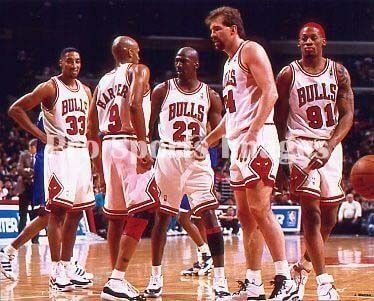
Was the 1990s the Best Decade the NBA Has Ever Seen? The Sporting Blog Tells All…
The National Basketball Association has been one of the “big three” sporting leagues for decades, alongside the National Football League and Major League Baseball.
For much of the last 50 years, the league has been driven by the presence of big-name stars; era-defining legends who go down as the best the league has ever seen.
In the 2000s, we all enjoyed watching the likes of LeBron James, Kobe Bryant, Steph Curry and Tim Duncan transform the sport. In more recent years, we’ve seen the globalisation of the league, with stars from Greece, Serbia, Cameroon and Canada all winning Most Valuable Player (MVP) trophies.
However, you don’t need to go far to find criticism of the modern game. Ask “old heads” about their perception of modern basketball, and it’s formulaic. Boring. Soft. Predictable. One-note. Not like the 1990s, they say.
Is that true, though? Was the 1990s NBA really that good? If so, what made it so unique? And is it really “better” than today? Let’s take a closer look!
What Made the 1990s NBA So Good?
So, most people who prefer 1990s basketball can point to a few things that make it better than the modern game. Most of the main arguments revolve around:
- A more physical play style that seemed more intense and likely to bring out the best in stars
- A more heated atmosphere in NBA stadiums, where fans seemed more committed to the game
- Rivalries that seemed to really bring out the best (or worst?) in everyone
- Player loyalty: players seemed to stick with just one team for longer
- Greater focus on isolation scoring and true 1v1 style basketball, forcing famous shots
- Charismatic players who seemed on the edge and carried themselves differently
- Dynastic play as the league switched from the Bad Boy Detroit Pistons to the Chicago Bulls
- The emergence not only of Michael Jordan, but also of other mega-stars like Shaquille O’Neal
- The bombastic style: the 1990s NBA matched the era’s style and fashion
Read our article about the NBA’s greatest super teams, including the 1995-1998 Bulls.
The Rivalries
In the 1990s, we had the famous Chicago Bulls team, which won six of six NBA Finals appearances. The Bulls finally overcame the Detroit Pistons, ending their run of three straight Finals appearances and going on to dominate the league. The Pistons and the Bulls hated one another — that kind of fierce, genuine dislike between teams isn’t something we tend to see anymore.
The New York Knicks and the Indiana Pacers were another huge rivalry of the 1990s — and that’s one that still exists today. Reggie Miller will forever be a villain in Madison Square Garden, and rightly so!
The Bulls had their own cadre of opponents, too. The likes of the Phoenix Suns, the Seattle Supersonics and the Utah Jazz tried their best to stop the Bulls. Nobody came close; the Bulls won all their Finals in six games or less.
In between the drama of Michael Jordan's retirement and return, you also had the New York Knicks — the darling of the media and arguably the biggest underachievers in NBA history — reach the Finals, as well as the Orlando Magic, led by the enigmatic Shaq.
The Characters
Characters existed on the sidelines and in the media. Coaches like Pat Riley, Phil Jackson and the emerging Greg Popovich were and are real characters. Guys like Rick Pitino became (in)famous. Even the Commissioner in the 1990s, David Stern, was a straight-shooting maverick compared to the PR-polished commissioner today, Adam Silver.
So, the era had a lot of relative parity. Lots of very good teams existed, many of which never even reached the Finals. Most of the good teams seemed a bit on the physical side, too. Flagrant two-style fouls were common, if they were even called. Hand checking allowed defenders to have far more control on the court, meaning lower scoring and more physical play to try “earn” a score.
It was an era where players like Dennis Rodman could thrive. Could Rodman make it in the league today? It’s hard to imagine, considering his playing style and personality. Players and coaches felt more like uber-talented “real” people than celebrities and brand ambassadors who could hoop.
The Play Style
Speaking of physicality, basketball in the 1990s was more “two-way” minded. Stars played both sides of the court. Michael Jordan, Charles Barkley and Hakeem Olajuwon — all major names of the 90s — were outstanding defenders and scorers.
Speaking of Hakeem, it was new for guys like him and Tim Duncan to appear; big men with incredible skill and footwork that seemed alien to the era of bruising Centres that came before them.
In the 90s, it was possible for a team to “rough it up” in the playoffs and turn a series around by simply being more brutal than they were in previous games. Do that today, and you’ll lose the series handily. Today, there are more rules to help prevent injury, but that also means a less visceral, physical game. As such, there’s more repetition and uniformity in how teams approach scoring.
That gritty style found its way into the crowds, too. Atmospheres were more tense — toxic at times. Fans seemed more into it. There was less of an idea of it being an entertainment event and more like going into a colosseum to watch a scrap to the finish. There was less visibility for mascots, timeout events, dancers and music blaring. It felt more intense on the court and inside the stands.
The Scarcity
We’ve still not covered one very important reason why the 1990s were so different, and that’s scarcity. Today, you can go on any number of websites and read about the NBA. Opinion pieces, fan podcasts, breaking news, social media… You can even watch games live.
In the 90s, you usually had to wait until the next day to find out what happened via the newspaper or local radio. There wasn’t as much NBA to watch, which means many fans who now look back on the 1990s with misty eyes actually didn’t see quite so many of those 64-61, 75-72, 88-81 style grindfests.
You had shows like the NBA on NBC, NBA Inside Stuff and local broadcasts. It was far less wall-to-wall than today. For some, less is more.
That said, in the 1990s, NBA teams had, on average, five players score double digits. Today, it’s around three. While you wouldn’t have as many people cracking the 25+ points per game margin, teams seemed to have more guys who could score just enough points.
In an era when teams averaged under 99 points per game, that would often be enough. Today, teams regularly score 120 and lose by 10+. There was a scarcity of scoring, which made every shot feel just a little bit bigger.
Could the NBA Ever Be Like the 1990s Again?
Everything comes back around, right? People are walking around in baggy trousers again, after all.
Yes, the conditions exist for a playing style like the 1990s NBA to return. The 2010s era was built on the Steph Curry archetype. The Golden State Warriors dominated. They played such a hard-to-stop brand of basketball that everyone tried to mimic it.
Most of the teams over the last 15 or so years have been three-point-focused teams built on five-out scoring systems. However, you don’t need to look too far to see teams playing a bit differently already.
The Oklahoma City Thunder don’t rely on the three-pointer. Instead, they play the kind of harrying, wild defence that feels like a throwback. They score a lot in transition and have a game that’s built around the mid-range mastery of Shai Gilgeous-Alexander.
Meanwhile, other emerging teams like the Detroit Pistons and the New York Knicks aren’t exactly playing Warriors-lite hoops, are they? All it takes is a combination of players who can build a system around physicality, intensity and not constantly kicking it out for three-pointers.
It would also take the league changing the rules to allow for more defensive plays without fouls being called. That’s a little harder to achieve, but the league adjusted for the Warriors era, so they’ll adjust to where success is and what fans want to see.
In terms of characters? Who knows. It’s impossible to say. The world is an entirely different place from the 1990s. Players are paid much more, and come under far more scrutiny. Your average All-Star player today probably receives a level of national coverage in line with what the superstars of the 90s did. There are more outlets and more platforms for discussion, both positive and negative.
It’s unlikely we’ll see society return to something akin to the 1990s anytime soon, so don’t expect stars of the next era to be quite as bold and brash as your favourite 90s stars. However, someone like Anthony Edwards feels like he could have emerged from a 1990s portal, with his play style and personality. A few more Anthony Edwards types, and who knows?
Is the 1990s NBA Better Than the Modern Era?
The NBA in the 90s was indeed spectacular. However, is it better than today? That’s entirely subjective.
People praise athleticism more than ever. The game's speed is incredible. There are far fewer isolation players; most of the biggest stars in the game are as happy to set up a teammate as they are to score themselves.
The 1990s, as thrilling as they were, had plenty of low-scoring, dour affairs where there would only be a couple of players on the court capable of tantalising the audience.
Today? Most teams have at least one player who can score a boatload. Teams regularly have multi-player systems that can see anyone on the team go off for a big scoring haul. While many claim the game is all about three-pointers and layups, platforms like Thinking Basketball show how this is simply not the case. The top teams in the league do not play the same way.
Yes, today’s game has fewer “characters” who might draw controversy. There is less physicality, thanks to a mixture of league rules, playing style and the fact that players don’t seem to share rivalries in the same way as they once did. The current NBA also has a scoring issue that’s hard to stop. And yes, more could be done to make the end of games more thrilling and less built around free throws.
But is it better? It’s hard to say. It depends on what you enjoy. Do you love dynasties built on stars that go on to win several titles in a row? Then yes, the 1990s were better. Do you prefer watching one-on-one plays where one star fights the other to score in the post, while the rest of the court watches on or waits for a rebound/kick-out? Yes, the 1990s were better.
It’s all down to personal opinion. Our personal view? It’s better to view both eras as what they are: separate from one another. You can still celebrate Jordan and the Bulls, or the 90s Knicks, or the end of the Bad Boy Pistons, or the rise of Kobe and Shaq, or anything else you loved about the 1990s, without denigrating today — and vice versa.
Basketball is still an incredible sport to watch, and the NBA remains one of the most competitive and fun leagues in the world. Why choose when you don’t have to?
Comments ()